
Our remarkable and resourceful contributor,
Joan Gurney, has sent two more articles for
inclusion in this OGA Newsletter. Although
written some 25 years ago, Joan says they
are her favourites. The contents echo some
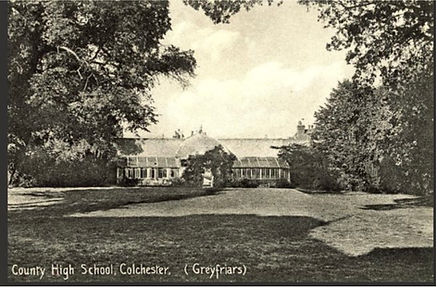
of her schoolday experiences at Grey Friars –
the tennis lawn and the small wildlife pond
near the eastern side of the magnificent and
original south facing conservatory (right); and
even if no nightingales were ever heard
there, Joan remembers that there was always
plenty of other birdsong!
Brief Encounter
.jpeg)
.jpeg)
The May Bank Holiday of 1999 was a perfect day
in every way – sunny and hot, with a clear blue sky. I spent the whole day working in, and around, my large pond (left). A solitary blue dragonfly skimmed the water. The water lily leaves had already reached the surface, promising that shortly the waxen-like flowers would emerge from the dark muddy depths, unfolding with an almost ethereal quality to reveal their shades of pure unblemished pink, white and burgundy. A skylark sang above the adjoining wildflower meadow, which in later weeks, would be a-flutter with Meadow Browns amidst the mauve shimmer
of delicate flowering grasses, before finally providing the intoxicating scent of new mown hay.
ll this countryside beauty, which I appreciate so much, had a special significance for me that year because, the previous Autumn, my sight had been seriously threatened by a sudden retinal detachment. It was, therefore, with a heavy heart, that I knew I had to leave this idyllic setting the next day to keep my sixthpost-operative appointment in London.
The grey overcast sky on Tuesday morning matched my mood. Although it was pleasantly mild and breezy, nothing that day, I believed, would compare with the sensuous experience of yesterday. I made my way to Colchester North Station to catch the 12.03pm train to London. I arrived on platform 3 15 minutes early. It was bleak and deserted. As I paced the platform, I was suddenly aware of an unusual birdsong. Perhaps all those winter weeks of enforced inactivity during which my vision was affected, had made me more acutely aware of sounds. Music had been my only
solace. Other things which are taken for granted –
reading, driving, birdwatching – were denied to me whilst I recovered my sight. But this sound I could hardly believe. I had not heard a nightingale since my childhood, and here it was in a very public place, in the middle of the day. Once heard, however, the song is never forgotten. The sheer range, richness, and variety of the penetrating song were
unmistakable. Bubbling and flute-like phrases, trills and piping notes – they were all there. For me, however, the most distinguishing feature was the slow, plaintive
.jpeg)
“sobbing” note repeated often, and with increasing volume until it reached its final crescendo. (above right: Nightingale – courtesy Visit Essex)
The shy and secretive songster (which is rarely seen) was well hidden in a small thicket alongside the lines, and it carried on singing uninterrupted as the platform gradually filled with people – suited gentlemen reading their newspapers, young women talking on their mobile ‘phones, teenagers listening to their Walkmans and restless infants playing with their toys. Nobody, through naivety or ignorance, took any notice of the continuing epic solo unfolding around them. I wanted to shout “Stop! Put those things away, and listen to something which you may never hear again.” I had fifteen minutes of ecstasy, and then the Intercity train form Norwich throbbed into the station, the passengers were swallowed up, and even as the doors slammed and the train moved off, the nightingale was still singing - magical notes rising above the noise of the busy station.
On the way back in the early evening, I remembered that I had been so enthralled by the bird’s performance that I had not noted the species of tree in the thicket from which it was singing (an important detail which would be needed for the National Nightingale Survey). So on arrival again in Colchester, I returned once more to the, now empty London platform. Only then did I realise that as my pupils had been dilated during my eye examination, I was unable to see the trees clearly enough to identify them accurately. From this thicket, the insignificant little bird with the outstanding repertoire may have carried on singing for several hours that afternoon – such is the energy and enthusiasm for stating his territory and attracting a mate during his short vocal season. All was not silent, however. The wind was moving round to the north and the evening was becoming cold. I hurried home.
It may be a complete myth that “A Nightingale Sang in Berkeley Square”, but it is an absolutely certainty that a nightingale sang at Colchester North Station on May 4th, in the final year of the millennium. It had made my day!